What Did the Athenians Tell Socrates Not to Do
The Apology of Socrates (Greek: Ἀπολογία Σωκράτους , Apología Sokrátous; Latin: Apologia Socratis), written by Plato, is a Socratic dialogue of the speech of legal cocky-defence which Socrates spoke at his trial for impiety and abuse in 399 BC.[1]
Specifically, the Apology of Socrates is a defence against the charges of "corrupting the youth" and "not believing in the gods in whom the metropolis believes, just in other daimonia that are novel" to Athens (24b).[ii]
Among the primary sources about the trial and decease of the philosopher Socrates (469–399 BC), the Amends of Socrates is the dialogue that depicts the trial, and is one of four Socratic dialogues, along with Euthyphro, Phaedo, and Crito, through which Plato details the final days of the philosopher Socrates.
The text of apology [edit]
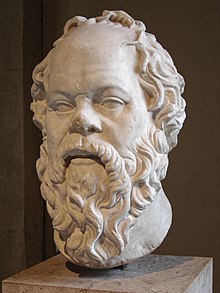
Bust of Socrates. Marble, Roman artwork (1st century), possibly a copy of a lost bronze statue by Lysippos.
The Apology of Socrates, past the philosopher Plato (429–347 BC), was one of many explanatory apologia about Socrates's legal defense force against accusations of corruption and impiety; almost apologia were published in the decade subsequently the Trial of Socrates (399 BC).[3] Every bit such, Plato's Apology of Socrates is an early philosophic defence of Socrates, presented in the form of a Socratic dialogue. Although Aristotle later classified it as a genre of fiction,[iv] [5] it is withal a useful historical source almost Socrates (469–399 BC) the philosopher.[vi] Aristotle believed the dialogue, peculiarly the scene where Socrates questions Meletus, represented a good use of interrogation.[7]
Except for Socrates'southward 2 dialogues with Meletus, nigh the nature and logic of his accusations of impiety, the text of the Apology of Socrates is in the first-person perspective and voice of the philosopher Socrates (24d–25d and 26b–27d). Moreover, during the trial, in his speech of cocky-defence, Socrates twice mentions that Plato is present at the trial (34a and 38b).
Introduction [edit]
The Apology of Socrates begins with Socrates addressing the jury of maybe 500 Athenian men to inquire if they take been persuaded by the Orators Lycon, Anytus, and Meletus, who accept accused Socrates of corrupting the immature people of the urban center and impiety against the pantheon of Athens. The first sentence of his voice communication establishes the theme of the dialogue — that philosophy begins with an admission of ignorance. Socrates later on clarifies that point of philosophy when he says that whatsoever wisdom he possesses comes from knowing that he knows zero (23b, 29b).
In the form of the trial, Socrates imitates, parodies, and corrects the Orators, his accusers, and asks the jury to guess him by the truth of his statements, not by his oratorical skill (cf. Lysias 19 1,2,3; Isaeus X i; Isocrates Xv 79; Aeschines Ii 24). Socrates says he will not employ sophisticated language — carefully arranged ornate words and phrases — but will speak using the common idiom of the Greek linguistic communication. Socrates says that he will speak in the way he has used in the agora and at the coin tables which he states is his native tongue and the fashion of his country. Although offered the opportunity to appease the prejudices of the jury, with a minimal concession to the charges of corruption and impiety, Socrates does not yield his integrity to avoid the punishment of death. The jury condemns Socrates to expiry.
Accusers of Socrates [edit]
In the society of 5th-century BC Athens, the three men who formally accused the philosopher Socrates of impiety and corruption against the people and the urban center, officially represented the interests of the politicians and the craftsmen, of the scholars, poets, and rhetoricians. The accusers of Socrates were:
- Anytus, a rich and socially prominent Athenian who opposed the Sophists on principle.[8] Socrates says that Anytus joined the prosecution considering he was "vexed on behalf of the craftsmen and politicians" (23e–24a); moreover, Anytus appears in the Meno dialogue (90f). Whilst Socrates and Meno (a visitor to Athens) are discussing Virtue, Anytus unexpectedly appears before them, and overhears their conversation. From the philosophic stance that virtue cannot be taught, Socrates adduces that many socially prominent Athenians take produced sons who are inferior to themselves, equally fathers; Socrates names several such men, including Pericles and Thucydides. In the event, Anytus is offended past the observation, and warns Socrates that stepping on people'southward toes (kakós legein) could, someday, cause trouble for him (Meno 94e–95a).
- Meletus, the only accuser to speak during Socrates's speech of self-defence force; he was the tool of Anytus, the truthful enemy of Socrates.[ix] Socrates says that Meletus joined the prosecution because he was "vexed on behalf of the poets" (23e); moreover, Meletus features in the Euthyphro dialogue. At trial, Socrates identifies Meletus as an unknown, swain with an aquiline nose. In the Apology of Socrates, Meletus agrees to be cross-examined by Socrates, whose questions lead Meletus into a semantic trap. Inattentive to the logical implications of his accusations of corruption and impiety, Meletus contradicts himself in accusing Socrates of atheism and of believing in demigods.
- Lycon, who represented the professional rhetoricians as an interest grouping.[x] Socrates says that Lycon joined the prosecution considering he was "vexed on behalf of the rhetoricians" (24a). That he joined the prosecution because he associated Socrates with the pro–Spartan Oligarchy of the 30 Tyrants (404 BC), who killed his son, Autolycus.[11] As a prosecutor of Socrates, Lycon also is a effigy of ridicule in a play past Aristophanes and had become a successful democratic pol in the commonwealth restored subsequently the fall of the Oligarchy of the Four Hundred (411 BC).[11]
- The accusations
In his defence force at trial, Socrates faced two sets of accusations: (i) asebeia (impiety) against the pantheon of Athens, by introducing new gods; and (2) abuse of Athenian youth, past teaching them to dubiety the condition quo. Socrates says to the court that these old accusations arise from years of gossip and prejudice against him; hence, are matters difficult to accost. He and then reformulates the diffuse accusations from the orators confronting him into the proper legal form: "Socrates is committing an injustice, in that he inquires into things below the earth and in the sky; and makes the weaker statement the stronger; and teaches others to follow his instance" (19b-c).
Socrates also says that the accusations for which he is answering in court already had been spoken and published by the comic poet Aristophanes, and are therefore across the legal scope of a trial for abuse and impiety. Years earlier, in the play The Clouds (423 BC), Aristophanes lampooned Socrates equally a charlatan, the paradigm philosopher of atheist and scientific sophistry — carefully bundled arguments constructed of ornate words and phrases — misrepresented as wisdom. In light of that definition, Socrates defensively argues that he cannot exist mistaken for a Sophist philosopher because Sophists are wise men, are thought to be wise past the people of Athens, and, thus, are highly paid for their teaching; whereas he (Socrates) lives in ten-thousand-fold poverty, and knows nada noble and skillful (23c).
- Impiety
For his self-defense force, Socrates first eliminates any merits that he is a wise human. He says that Chaerephon, reputed to be impetuous, went to the Oracle of Delphi and asked her, the prophetess, Pythia, to tell him of anyone wiser than Socrates. The Pythia answered to Chaerephon that there was no man wiser. On learning of that oracular pronouncement, Socrates says he was astounded, because, on the one hand, it is against the nature of the Oracle to lie, only, on the other hand, he knew he was not wise. Therefore, Socrates sought to detect someone wiser than himself, so that he could have that person every bit evidence to the Oracle at Delphi. Hence why Socrates minutely queried everyone who appeared to be a wise person. In that vein, he tested the minds of politicians, poets, and scholars, for wisdom; although he occasionally found genius, Socrates says that he institute no ane who possessed wisdom; yet, each man was idea wise by the people, and each human thought himself wise; therefore, he thought he was the better human, because he was aware that he was not wise.
- Corruption of the Athenian youth
Socrates explained that the young, rich men of the city of Athens have little to exercise with their time. They, therefore, follow him about the city, observing his questioning of intellectual arguments in dialogue with other intellectual men. In turn, young men imitate the method of Socrates. Socrates idea that the arguments of the men he examined were wanting, and when he said this, to not lose face, they would restate stock accusations against Socrates; that he is a morally abominable man who corrupts the youth of Athens with sophistry and atheism. In his defence, Socrates said: "For those who are examined, instead of existence angry with themselves, are angry with me!".
The dialogue [edit]
The Apology of Socrates, by Plato, is a Socratic dialogue in three parts that embrace the Trial of Socrates (399 BC): (i) the legal self-defence of Socrates, (two) the verdict of the jury, and (3) the sentence of the court.
Office ane: The defence of Socrates [edit]
Socrates begins his legal defence force past telling the jury that their minds were poisoned by his enemies when they (the jury) were immature and impressionable. He as well says that his false reputation as a sophistical philosopher comes from his enemies and that all of them are malicious, yet must remain nameless — except for the playwright Aristophanes, who lampooned him (Socrates) every bit a adventurer-philosopher in the comedy play The Clouds (423 BC). Nearly corrupting the rich, young men of Athens, Socrates argues that deliberate corruption is an casuistic action because information technology would hurt him, besides. He says that the accusations of him beingness a corrupter of youth began at the time of his obedience to the Oracle at Delphi, and tells how Chaerephon went to the Oracle, to ask her, the Pythian prophetess, if in that location was a man wiser than Socrates.[12] When Chaerephon reported to him that the Oracle said there is no wiser man, Socrates interpreted that divine report equally a riddle — because he was enlightened of possessing no wisdom "great or small", and that lying is not in the nature of the gods.
- The wisest man
Socrates so sought to solve the divine paradox — how an ignorant man as well could exist the wisest of all men — in effort to illuminate the meaning of the Oracles' categorical statement that he is the wisest human being in the land. Afterwards systematically interrogating the politicians, the poets, and the craftsmen, Socrates determined that the politicians were not wise like he was. He says of himself, in reference to a politician: "I am wiser than this human being; it is probable that neither of us knows anything worthwhile, but he thinks he knows something when he does not."(21d).[thirteen] Socrates says that the poets did not understand their poetry; that the prophets and seers did not understand what they said; and that the craftsmen while knowing many things, thought they besides had much knowledge on things of which they had none. In that light, Socrates saw himself as a spokesman for the Oracle at Delphi (22e). He asked himself if he would rather be an impostor, like the "wise people" he interrogated, or if he would rather be himself, Socrates of Athens. Socrates tells the jury that he would rather be himself than be anyone else. He says that in searching for a human being wiser than himself, he came to be regarded as a social gadfly and acquired a bad reputation amidst Athens' politically powerful personages.
- Corrupter of youth
Having addressed the social prejudices against him, Socrates addresses the first accusation — the moral abuse of Athenian youth — by accusing his accuser, Meletus, of being indifferent to the persons and things about which he professes to care. Whilst interrogating Meletus, Socrates says that no one would intentionally corrupt another person — because the corrupter subsequently stands to be harmed in vengeance by the corrupted person. The matter of moral abuse is important for ii reasons: (i) the accusation is that Socrates corrupted the rich, young men of Athens by pedagogy atheism; (ii) that if he is convicted of corruption, it volition be because the playwright Aristophanes already had corrupted the minds of his audience, when they were young, past lampooning Socrates as the "Sophistical philosopher" in The Clouds, a comic play produced virtually 20-4 years before.
- Atheist
Socrates and then addresses the second accusation — asebeia (impiety) against the pantheon of Athens — by which Meletus says that Socrates is an atheist. In cross-exam, Socrates leads Meletus to contradict himself: that Socrates is an atheist who also believes in spiritual agencies and demigods. Socrates tells the judges that Meletus has contradicted himself and and so asks if Meletus has designed a test of intelligence for identifying logical contradictions.
On death
Socrates gain to say that people who fear death are showing their ignorance, because decease might exist a skillful thing, all the same people fear it as if it is evil; even though they cannot know whether it is good or evil. Socrates says that his wisdom is in existence enlightened that he is ignorant on this, and other topics. [xiii]
- Precedence of authority
Regarding a citizen'south obedience to authorization, Socrates says that a lawful potency, either human or divine, should always exist obeyed. In a conflict of obedience to such authorities, he thinks that obeying divine authority supersedes obeying human authority: "Gentlemen, I am your grateful and devoted retainer, but I owe a greater obedience to the [Delphic] god than to you; and, as long as I draw breath and take my faculties, I shall never stop practising philosophy"(29d). Every bit a spokesman for the Oracle at Delphi, he is to spur the Athenians to greater awareness of ethics and moral bear and always shall question and argue. Therefore, the philosopher Socrates of Athens asks his fellow citizens: "Are you not ashamed that you give your attention to acquiring as much money as possible, and similarly with reputation and honour, and give no attention or idea to truth and understanding, and the perfection of your soul?"(29e)
- Provocateur
Granting no concession to his precarious legal state of affairs, Socrates speaks emotionally and provocatively to the court and says that the greatest good to occur upon Athens is his moral business for them equally swain citizens. He thinks that material wealth is a event of goodness; that the god does not permit a amend homo to exist harmed past a lesser man; and that he is the social gadfly required by Athens: "All day long, I will never cease to settle hither, there, and everywhere — rousing, persuading, and reproving every one of you." In back up of the moral mission assigned him by the Oracle at Delphi, Socrates tells the courtroom that his daimonion continually forbids him to act unethically (implicitly validating Meletus' accusation that Socrates believes in novel deities not of the Athenian pantheon).
Socrates says he never was a paid teacher; therefore, he is not responsible for the corruption of any Athenian citizen. If he had corrupted anyone, he asks: why have they non come frontward to bear witnesses? If the corrupted Athenians are ignorant of having been corrupted, then why take their families non spoken on their behalf? Socrates indicates, in signal of fact, relatives of the Athenian youth he supposedly corrupted are present in court, giving him moral support.
Socrates concludes his legal defence by reminding the judges that he shall non resort to emotive tricks and arguments, shall not cry in public regret, and that his three sons will not announced in court to pathetically sway the judges. Socrates says he is not afraid of decease and shall not act opposite to religious duty. He says he volition rely solely upon sound argument and truth to nowadays his case at trial.
Rhetoric
In Plato's version of the trial, Socrates mocks oratory as a deceitful rhetorical practise designed to lead jurors away from the truth. Some scholarship, however, views this mockery just equally a critique of narrow views of rhetoric-as-speechmaking and, in plow, sees the whole trial as an implicit depiction of a more than expansive view of rhetoric that unfolds over the course of a lifetime.[14]
Part two: Socrates' sentencing plea [edit]
The jurors of the trial voted the guilt of Socrates by a relatively narrow margin(36a). In the Amends of Socrates, Plato cites no full numbers of votes condemning or acquitting the philosopher of the accusations of moral abuse and impiety;[fifteen] [16] Socrates says that he would have been acquitted if thirty more jurors had voted in his favour.[sixteen] This would likely mean that if the court were composed of 500 people then 280 voted against Socrates and 220 voted in his favor. This would make the margin about 12 percent.[17] In such cases — where the penalty of death might arise as a legal sanction for the accusations is presented — Athenian police required that the prosecutor and the defendant each propose an authoritative penalty to punish the deportment reported in the accusations.
Socrates antagonises the court past proposing, rather than a penalty, a advantage — perpetual maintenance at public expense. He notes that the vote of judgement against him was close. In that vein, Socrates then engages in dark humour, suggesting that Meletus narrowly escaped a keen fine for non meeting the statutory requirement of receiving one-fifth of the votes of the assembled judges in favour of his accusations against Socrates. In that way, Socrates published the fiscal result for Meletus to consider as a plaintiff in a lawsuit — because the Athenian legal system discouraged frivolous lawsuits by imposing a financially onerous fine upon the plaintiff if the vote of the judges was less than one-fifth of the number of judges required by the type of lawsuit.
As penalty for the 2 accusations formally presented against him at trial, Socrates proposed to the court that he exist treated as a benefactor to the city of Athens; that he should be given free meals, in perpetuity, at the Prytaneum, the public dining hall of Athens. Receiving such public largesse is an honour reserved for Olympic athletes, prominent citizens, and benefactors of Athens, as a metropolis and equally a state.
Finally, after the court dismisses the proposed reward — free meals at the Prytaneum — Socrates considers imprisonment and banishment, earlier settling upon a punishment fine of 100 drachmae. Despite his poverty, this was a pocket-sized penalty compared to the death penalty proposed by the prosecutors, and encouraged by the judges of the trial. His supporters, Plato, Crito, Critobulus, and Apollodorus offered even more money to pay as a fine – 3,000 drachmae (xxx minae);[xviii] nonetheless, to the judges of the trial of Socrates, a pecuniary fine was bereft punishment.
[edit]
In the Trial of Socrates, the judgement of the court was decease for Socrates; most of the jurors voted for the death sentence (Apology 38c), however Plato provides no jury-vote numbers in the text of the Apology of Socrates; only Diogenes Laërtius reports that 280 jurors voted for the death sentence and 220 jurors voted for a pecuniary fine for Socrates (ii.42).[xix] Moreover, the politically provocative language and irreverent tone of Socrates's self-defence speech communication angered the jurors and invited their punishment of him.[20]
Socrates responds to the decease-penalty verdict by commencement addressing the jurors who voted for his death. He says that instead of waiting a short time for him to die from old age, they will now have to accept the harsh criticisms from his supporters. He prophesied that his expiry will cause the youngsters to come frontward and replace him as a social gadfly, spurring upstanding conduct from the citizens of Athens, in a way more vexing than him(39d).
To the jurors who voted to behave him, Socrates gives encouragement: his supernatural daimonion did not interfere with his comport of the legal defense, which he viewed as a sign that such a defence was the correct action. In that way, the daimonion communicated to Socrates that death might exist a skillful thing; either expiry is anything (release from earthly worry) and not to exist feared, or expiry is migration to a higher plane of existence in which reside the souls of personages and heroes, such as Hesiod and Homer and Odysseus.
Socrates concludes his self-defence by proverb to the court that he bears no ill-will, neither towards his accusers — Lycon, Anytus, and Meletus — nor the jurors. He so asks the Athenians to correct his iii sons if they value material wealth more living virtuously, or if they get too prideful; and in doing that, justice volition finally be served.
Adaptations [edit]
- Socrates on Trial: A Play Based on Aristophane's Clouds and Plato's Apology, Crito, and Phaedo Adjusted for Modern Performance (2007), by Andrew David Irvine, is a contemporary play that portrays Socrates every bit philosopher and man, based upon The Clouds (423 BC), by Aristophanes, and three Socratic dialogues, past Plato, the Apology of Socrates (the philosopher'south defence force at trial), the Crito (discussion of the nature of Justice), and the Phaedo (discussion of the nature of the Afterlife).
- Roberto Rossellini'southward 1971 television film Socrates largely lifts its action and script from this dialogue.
Texts and translations [edit]
- Greek text at Perseus
- Plato: Euthyphro, Apology, Crito, Phaedo, Phaedrus. Greek with translation by Harold N. Fowler. Loeb Classical Library 36. Harvard Univ. Press (originally published 1914).
- Fowler translation at Perseus
- Plato: Euthyphro, Apology, Crito, Phaedo. Greek with translation by Chris Emlyn-Jones and William Preddy. Loeb Classical Library 36. Harvard Univ. Press, 2017. ISBN 9780674996878 HUP listing
- Plato. Opera, book I. Oxford Classical Texts. ISBN 978-0198145691
- Plato. Complete Works. Hackett, 1997. ISBN 978-0872203495
- The Last Days of Socrates, translation of Euthyphro, Apology, Crito, Phaedo. Hugh Tredennick, 1954. ISBN 978-0140440379. Made into a BBC radio play in 1986.
Come across as well [edit]
- Otium
- Trial of Socrates
References [edit]
- ^ Plato; Estienne, Henri; Serres, Jean de; Adams, John; Adams, John Quincy (1578). "Platonis opera quae extant omnia". archive.org. [Genevae?] : Excudebat Henr. Stephanus. p. 17.
- ^ "Socrates," Stanford Encyclopedia of Philosophy, 16 Sept. 2005. See: Doug Lindner, "The Trial of Socrates, "Univ. of Missouri-Kansas City Law Schoolhouse 2002.
- ^ Schofield, Malcolm (2016). "Plato (427–347 BC)". Routledge Encyclopedia of Philosophy. doi:10.4324/9780415249126-A088-1. ISBN9780415250696 . Retrieved 23 July 2008.
- ^ Guthrie, W. Grand. C. (1986). A History of Greek Philosophy: Volume iv, Plato: The Man and His Dialogues: Before Period. Cambridge University Printing. pp. 71–72. ISBN978-0-521-31101-4.
- ^ Kahn, Charles H. (1998). Plato and the Socratic Dialogue: The Philosophical Use of a Literary Form. Cambridge University Press. p. 46. ISBN978-0-521-64830-1.
- ^ Brickhouse, Thomas; Smith, Nicholas D. "Plato". Internet Encyclopedia of Philosophy.
- ^ Rhetoric, Aristotle
- ^ The Oxford Classical Lexicon 1966, p. 65
- ^ The Oxford Classical Dictionary 1966, p. 554
- ^ Plato (1916). Adam, James (ed.). Platonis Apologia Socratis. Cambridge Academy Press. p. xxvi.
- ^ a b Nails, Debra (2002). The People of Plato: A Prosopography of Plato and Other Socratics. Hackett Publishing. pp. 188–189. ISBN978-1-60384-027-9.
- ^ Plato (1924). "The Dialogues of Plato". Translated by Jowett, Benjamin. Oxford Academy Printing, American branch.
- ^ a b Plato (2000). The Trial and Expiry of Socrates . Translated by Grube, G. M. A. (Third ed.). Hackett Publishing Visitor. p. 25. ISBN978-0-87220-554-iii.
- ^ Bjork, Collin (2021). "Plato, Xenophon, and the Uneven Temporalities of Ethos in the Trial of Socrates". Philosophy & Rhetoric. 54 (3): 240–262. doi:10.5325/philrhet.54.3.0240. ISSN 0031-8213. JSTOR 10.5325/philrhet.54.iii.0240. S2CID 244334227.
- ^ Plató; Burnet, John (1924). Plato's Euthyphro, Apology of Socrates, and Crito. Clarendon Press. pp. 150–151. ISBN9780198140153.
- ^ a b Brickhouse & Smith 1990, p. 26.
- ^ Barnes and Noble, Essential Dialogues of Plato
- ^ Eliot, Charles William (1909). "The Harvard Classics: Plato: The Apology, Phaedo, and Crito ; The aureate sayings of Epictetus ; The meditations of Marcus Aurelius". P. F. Collier & Son.
- ^ Brickhouse & Smith 1990, pp. 230–231.
- ^ MacDowell, Douglas Maurice (1986). The Law in Classical Athens. Cornell University Printing. p. 253. ISBN978-0-8014-9365-2.
Bibliography [edit]
- Brickhouse, Thomas C.; Smith, Nicholas D. (1990). Socrates on Trial. Clarendon Press. ISBN978-0-19-823938-3.
- Hammond, Scullard H. H. (1966). The Oxford Classical Dictionary (7th Printing ed.). Oxford.
Farther reading [edit]
- Allen, Reginald E. (1980). Socrates and Legal Obligation. Minneapolis: University of Minnesota Press.
- Brickhouse, Thomas C. (1989). Socrates on Trial. Princeton: Princeton University Press.
- Brickhouse, Thomas C.; Smith, Nicholas D. (2004). Routledge Philosophy Guidebook to Plato and the Trial of Socrates. New York: Routledge.
- Cameron, Alister (1978). Plato's Affair with Tragedy. Cincinnati: University of Cincinnati.
- Compton, Todd, "The Trial of the Satirist: Poetic Vitae (Aesop, Archilochus, Homer) as Groundwork for Plato's Apology", The American Journal of Philology, Vol. 111, No. 3 (Fall, 1990), pp. 330–347, The Johns Hopkins University Press
- Fagan, Patricia; Russon, John (2009). Reexamining Socrates in the Amends. Evanston: Northwestern University Press.
- Hackforth, Reginald (1933). The Composition of Plato'south Apology. Cambridge: Cambridge University Press.
- Irvine, Andrew David (2008). Socrates on Trial: A Play Based on Aristophanes' Clouds and Plato's Apology, Crito, and Phaedo Adapted for Mod Performance. Toronto: University of Toronto Press. ISBN 978-0-8020-9783-5 (fabric); ISBN 978-0-8020-9538-1 (newspaper); ISBN 978-1-4426-9254-1 (e-pub)
- Reeve, C.D.C. (1989). Socrates in the Apology . Indianapolis: Hackett. ISBN0872200892.
- West, Thomas G. (1979). Plato's Amends of Socrates . Ithaca: Cornell University Press.
- Stone, I. F. (1988). The Trial of Socrates . Boston: Piffling, Dark-brown.
External links [edit]
- Translated past Woods & Pack, 2010
- Arranged with Euthyphro, Crito and the death scene from Phaedo
- Project Gutenberg has English translations of Plato's Amends of Socrates:
- Translated by Benjamin Jowett, 1891
- Bundled with Plato'southward Crito and Phaedo, translated by Henry Cary, introduced by Edward Brooks Jr. 1901
-
 The Amends public domain audiobook at LibriVox
 - The Apology of Socrates, free professional person-quality downloadable audio book (function i as parts are indicated in this article) from ThoughtAudio.com, in the translation by Benjamin Jowett
- Approaching Plato: A Guide to the Early and Middle Dialogues
- Guides to the Socratic Dialogues: Plato's Apology, a beginner'south guide to the Apology, by Dale E. Burrington (from Internet Annal fill-in)
- G. Theodoridis, 2015: full-text translation
Source: https://en.wikipedia.org/wiki/Apology_(Plato)
0 Response to "What Did the Athenians Tell Socrates Not to Do"
Post a Comment